> ## Documentation Index
> Fetch the complete documentation index at: https://docs.trysquad.ai/llms.txt
> Use this file to discover all available pages before exploring further.
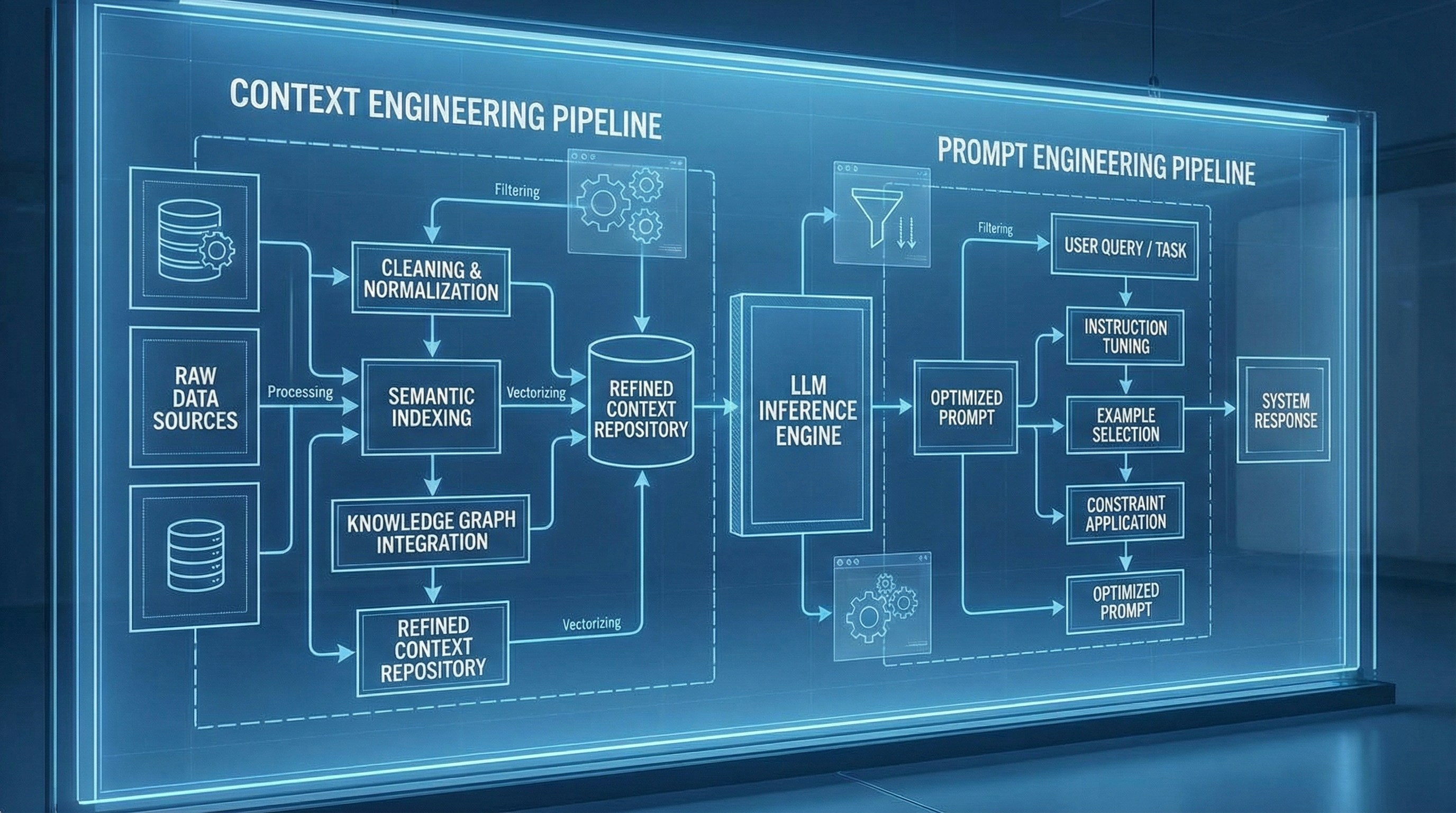
# Context Engineering Is Not Prompt Engineering
> Google's ADK, Stanford's ACE paper, and Squad independently arrived at the same insight: context is a compiled view over stateful systems, not a string to optimize. Here's what we learned before the docs existed.
 **Author:** Danial Hasan, CTO @ Squad
## The Convergence
Three independent teams just validated the same architectural insight:
**Google ADK (3 days ago):**
> "Context is a compiled view over a richer stateful system."
**Stanford/SambaNova ACE paper (October 2025):**
> "Treat contexts as evolving playbooks that accumulate, refine, and organize strategies."
**Squad (months ago, in production):**
> "We learned this a few months ago when building our active context management systems."
When Google's agent framework team, Stanford researchers, and a startup building multi-agent systems **all independently arrive at the same architecture**, that architecture is probably correct.
***
## The Problem We Hit
**Month 1 of Squad:**
```
Agent A gathers context (5,000 tokens)
Agent A passes everything to Agent B
Agent B receives 5,000 tokens of "history"
Agent B starts saying "As I mentioned earlier..."
Agent B never mentioned anything. Agent A did.
```
**Identity confusion.** Agent B hallucinated that it had Agent A's conversation.
This wasn't a prompt problem. Our prompts were clear: "You are Agent B, the Engineer."
It was a **context problem.** We flooded Agent B with Agent A's history, and the model couldn't distinguish "context I'm receiving" from "conversation I'm having."
**The failure rate:** 39% of multi-agent handoffs had identity confusion artifacts.
***
## The Wrong Mental Model
Most agent frameworks handle context like this:
```python theme={null}
context = ""
context += system_prompt
context += user_message
context += tool_result_1
context += tool_result_2
context += agent_response
# ... keep appending forever
```
**This is prompt engineering thinking applied to context.** It treats context as a string to optimize, not a system to architect.
***
## The Compiler Mental Model
**Source code (what you store):**
* Sessions
* Memory
* Artifacts (files)
* Full structured state
**Compiler pipeline (how you transform):**
* Named processors
* Sequence of passes
* Observable transformations
**Compiled output (what the model sees):**
* Working context
* Minimal, relevant, scoped to this call
### Squad's Three-Tier Architecture
```
┌─────────────────────────────────────────────┐
│ TIER 3: IMMUTABLE (Audit Log) │
│ - All receipts ever generated │
│ - Storage: S3 / long-term │
├─────────────────────────────────────────────┤
│ TIER 2: PERSISTENT (Shared Database) │
│ - Current task context │
│ - Frozen contracts │
│ - Storage: Vector DB + Relational DB │
├─────────────────────────────────────────────┤
│ TIER 1: EPHEMERAL (Working Context) │
│ - What THIS agent sees for THIS call │
│ - Compiled from Tier 2 + Tier 3 │
│ - Storage: LLM context window │
└─────────────────────────────────────────────┘
```
***
## The Multi-Agent Identity Fix
**Wrong:** Pass Agent A's conversation to Agent B as history.
**Right:** Transform Agent A's outputs into context FOR Agent B.
```typescript theme={null}
// Wrong: Copy conversation
const engineerContext = scoutConversation
// Right: Transform to third-person context
const engineerContext = {
role: "system",
content: `
Context from Scout Agent (separate agent):
- Files identified: ${scout.outputs.files}
- Patterns detected: ${scout.outputs.patterns}
You are the Engineer Agent. Use this context to implement.
`
}
```
**The difference:**
* Scout's outputs become Engineer's **context**, not **history**
* Clear attribution: "Scout found..." not "I found..."
* No identity confusion
**Results:**
* Before: 39% identity confusion
* After: 2% identity confusion
***
## Evidence: Before vs After
### Before Context Engineering (Month 1-2)
| Metric | Value |
| -------------------- | ----------- |
| Average context size | 180K tokens |
| Context relevance | 34% |
| Identity confusion | 39% |
| Task success rate | 61% |
| Cost per task | \$2.40 |
### After Context Engineering (Month 4+)
| Metric | Value | Change |
| -------------------- | ---------- | --------- |
| Average context size | 48K tokens | **-73%** |
| Context relevance | 91% | **+168%** |
| Identity confusion | 2% | **-95%** |
| Task success rate | 94% | **+54%** |
| Cost per task | \$0.77 | **-68%** |
***
## The Reach, Don't Flood Principle
**Google's ADK:** "Agents should reach for information via tools, not get flooded with everything upfront."
```typescript theme={null}
// Bad: Flood agent with all possible context
const context = {
allFiles: await readAllFiles(), // 50,000 tokens
allTests: await getAllTestResults(), // 10,000 tokens
allDocs: await getAllDocumentation(), // 30,000 tokens
// Total: 90,000+ tokens (most irrelevant)
}
// Good: Minimal default + tools to reach for more
const context = {
task: currentTask, // 500 tokens
contracts: frozenContracts, // 300 tokens
recentContext: last3Turns, // 800 tokens
// Total: 1,600 tokens
}
const tools = [
readFile, // Agent reaches for specific files
runTests, // Agent reaches for test results
searchDocs, // Agent reaches for relevant docs
]
```
**Results:**
* 75% token reduction
* +3.2 tool calls per task (agents reaching for what they need)
* 94% task success rate
* 68% cost reduction
***
This is a scaffold post. Full content will include:
* Complete compilation pipeline code
* Processor architecture details
* Google ADK comparison table
* Stanford ACE paper insights
* Meta MSL validation
* Practical implementation guide
***
## The Meta-Point
Four independent teams arrived at the same architecture:
| Principle | Google ADK | ACE Paper | Meta MSL | Squad |
| ------------------------ | --------------------------- | ------------------------------- | --------------------------- | ---------------------- |
| Storage ≠ Presentation | Sessions vs Working Context | Playbooks vs Delta Updates | Environments vs Evaluations | Tiers vs Compiled View |
| Explicit Transformations | LLM Flows + Processors | Generator → Reflector → Curator | Verifier Pipeline | Named Processor Chain |
| Scope by Default | Tools reach for more | Incremental updates | Constraint-scoped | Protocol-based access |
**This isn't coincidence. This is convergent evolution toward correct architecture.**
***
**Related Reading:**
* [Google ADK Context Engineering](https://google.github.io/adk-docs/context/)
* [ACE: Agentic Context Engineering (arXiv:2510.04618)](https://arxiv.org/abs/2510.04618)
* [Meta AI Engineer Validation](/blog/meta-ai-engineer-validation)
* [Context Management Multi-Agent](/blog/context-management-multi-agent)
**Author:** Danial Hasan, CTO @ Squad
## The Convergence
Three independent teams just validated the same architectural insight:
**Google ADK (3 days ago):**
> "Context is a compiled view over a richer stateful system."
**Stanford/SambaNova ACE paper (October 2025):**
> "Treat contexts as evolving playbooks that accumulate, refine, and organize strategies."
**Squad (months ago, in production):**
> "We learned this a few months ago when building our active context management systems."
When Google's agent framework team, Stanford researchers, and a startup building multi-agent systems **all independently arrive at the same architecture**, that architecture is probably correct.
***
## The Problem We Hit
**Month 1 of Squad:**
```
Agent A gathers context (5,000 tokens)
Agent A passes everything to Agent B
Agent B receives 5,000 tokens of "history"
Agent B starts saying "As I mentioned earlier..."
Agent B never mentioned anything. Agent A did.
```
**Identity confusion.** Agent B hallucinated that it had Agent A's conversation.
This wasn't a prompt problem. Our prompts were clear: "You are Agent B, the Engineer."
It was a **context problem.** We flooded Agent B with Agent A's history, and the model couldn't distinguish "context I'm receiving" from "conversation I'm having."
**The failure rate:** 39% of multi-agent handoffs had identity confusion artifacts.
***
## The Wrong Mental Model
Most agent frameworks handle context like this:
```python theme={null}
context = ""
context += system_prompt
context += user_message
context += tool_result_1
context += tool_result_2
context += agent_response
# ... keep appending forever
```
**This is prompt engineering thinking applied to context.** It treats context as a string to optimize, not a system to architect.
***
## The Compiler Mental Model
**Source code (what you store):**
* Sessions
* Memory
* Artifacts (files)
* Full structured state
**Compiler pipeline (how you transform):**
* Named processors
* Sequence of passes
* Observable transformations
**Compiled output (what the model sees):**
* Working context
* Minimal, relevant, scoped to this call
### Squad's Three-Tier Architecture
```
┌─────────────────────────────────────────────┐
│ TIER 3: IMMUTABLE (Audit Log) │
│ - All receipts ever generated │
│ - Storage: S3 / long-term │
├─────────────────────────────────────────────┤
│ TIER 2: PERSISTENT (Shared Database) │
│ - Current task context │
│ - Frozen contracts │
│ - Storage: Vector DB + Relational DB │
├─────────────────────────────────────────────┤
│ TIER 1: EPHEMERAL (Working Context) │
│ - What THIS agent sees for THIS call │
│ - Compiled from Tier 2 + Tier 3 │
│ - Storage: LLM context window │
└─────────────────────────────────────────────┘
```
***
## The Multi-Agent Identity Fix
**Wrong:** Pass Agent A's conversation to Agent B as history.
**Right:** Transform Agent A's outputs into context FOR Agent B.
```typescript theme={null}
// Wrong: Copy conversation
const engineerContext = scoutConversation
// Right: Transform to third-person context
const engineerContext = {
role: "system",
content: `
Context from Scout Agent (separate agent):
- Files identified: ${scout.outputs.files}
- Patterns detected: ${scout.outputs.patterns}
You are the Engineer Agent. Use this context to implement.
`
}
```
**The difference:**
* Scout's outputs become Engineer's **context**, not **history**
* Clear attribution: "Scout found..." not "I found..."
* No identity confusion
**Results:**
* Before: 39% identity confusion
* After: 2% identity confusion
***
## Evidence: Before vs After
### Before Context Engineering (Month 1-2)
| Metric | Value |
| -------------------- | ----------- |
| Average context size | 180K tokens |
| Context relevance | 34% |
| Identity confusion | 39% |
| Task success rate | 61% |
| Cost per task | \$2.40 |
### After Context Engineering (Month 4+)
| Metric | Value | Change |
| -------------------- | ---------- | --------- |
| Average context size | 48K tokens | **-73%** |
| Context relevance | 91% | **+168%** |
| Identity confusion | 2% | **-95%** |
| Task success rate | 94% | **+54%** |
| Cost per task | \$0.77 | **-68%** |
***
## The Reach, Don't Flood Principle
**Google's ADK:** "Agents should reach for information via tools, not get flooded with everything upfront."
```typescript theme={null}
// Bad: Flood agent with all possible context
const context = {
allFiles: await readAllFiles(), // 50,000 tokens
allTests: await getAllTestResults(), // 10,000 tokens
allDocs: await getAllDocumentation(), // 30,000 tokens
// Total: 90,000+ tokens (most irrelevant)
}
// Good: Minimal default + tools to reach for more
const context = {
task: currentTask, // 500 tokens
contracts: frozenContracts, // 300 tokens
recentContext: last3Turns, // 800 tokens
// Total: 1,600 tokens
}
const tools = [
readFile, // Agent reaches for specific files
runTests, // Agent reaches for test results
searchDocs, // Agent reaches for relevant docs
]
```
**Results:**
* 75% token reduction
* +3.2 tool calls per task (agents reaching for what they need)
* 94% task success rate
* 68% cost reduction
***
This is a scaffold post. Full content will include:
* Complete compilation pipeline code
* Processor architecture details
* Google ADK comparison table
* Stanford ACE paper insights
* Meta MSL validation
* Practical implementation guide
***
## The Meta-Point
Four independent teams arrived at the same architecture:
| Principle | Google ADK | ACE Paper | Meta MSL | Squad |
| ------------------------ | --------------------------- | ------------------------------- | --------------------------- | ---------------------- |
| Storage ≠ Presentation | Sessions vs Working Context | Playbooks vs Delta Updates | Environments vs Evaluations | Tiers vs Compiled View |
| Explicit Transformations | LLM Flows + Processors | Generator → Reflector → Curator | Verifier Pipeline | Named Processor Chain |
| Scope by Default | Tools reach for more | Incremental updates | Constraint-scoped | Protocol-based access |
**This isn't coincidence. This is convergent evolution toward correct architecture.**
***
**Related Reading:**
* [Google ADK Context Engineering](https://google.github.io/adk-docs/context/)
* [ACE: Agentic Context Engineering (arXiv:2510.04618)](https://arxiv.org/abs/2510.04618)
* [Meta AI Engineer Validation](/blog/meta-ai-engineer-validation)
* [Context Management Multi-Agent](/blog/context-management-multi-agent)