Temporal Coupling Problem Author: Danial Hasan, CTO @ Squad

The Problem Every AI Agent Has

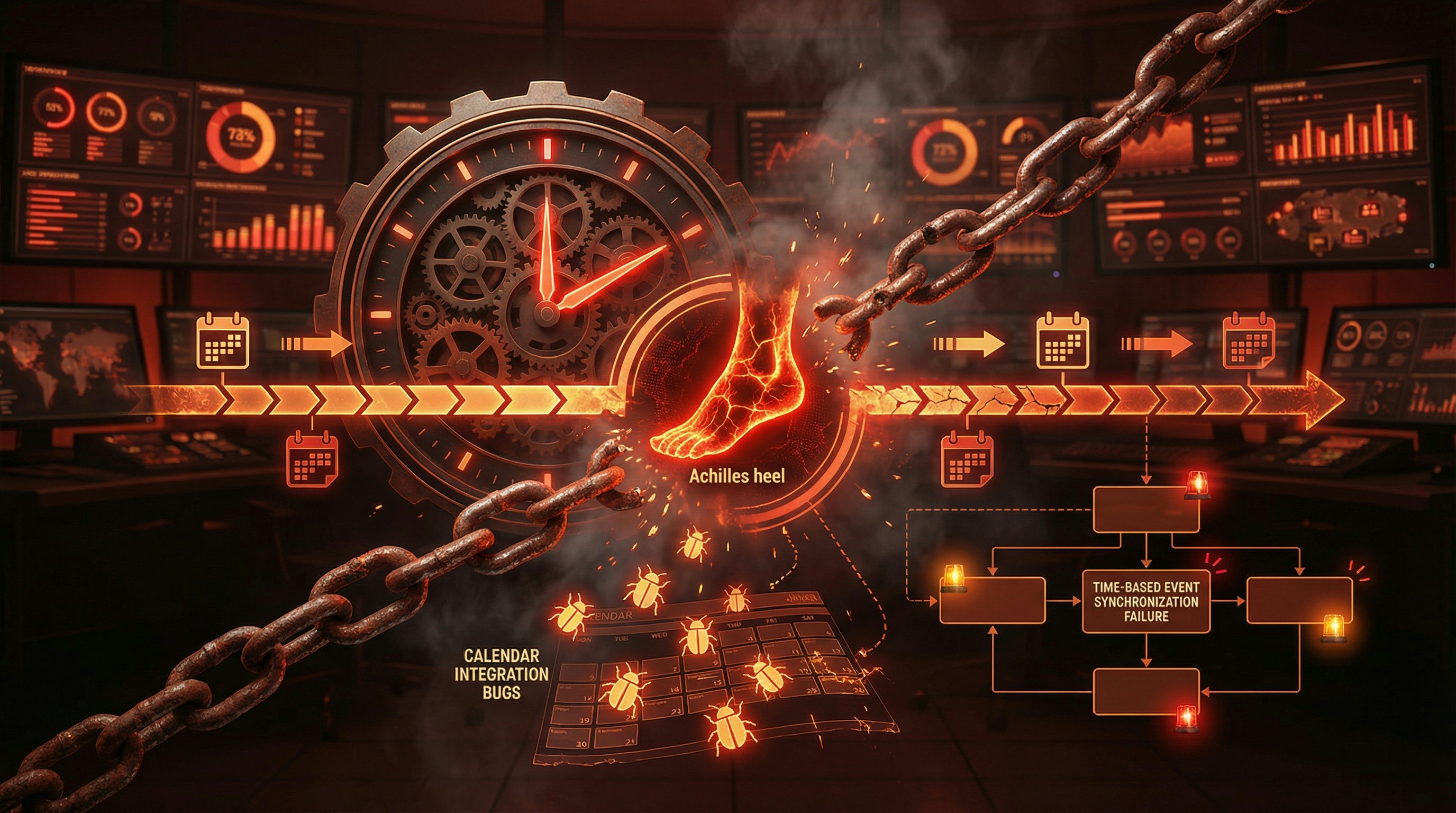
Every AI agent operates on a snapshot of reality. When reality changes after the snapshot, the agent doesn’t know. Real failure (happened to us):
10:00 AM: Agent reads calendar, sees 2 PM free
10:05 AM: User books meeting at 2 PM (external change)
10:10 AM: Agent schedules ANOTHER meeting at 2 PM
Result: Double-booking, angry users
Business stakes:
  • 37% of agent failures trace to temporal issues (our production data)
  • Users lose trust after one temporal failure
  • Can’t scale autonomous agents if they break when reality changes

Why Traditional Solutions Don’t Work

Attempt 1: Poll More Frequently

while task_not_done:
    current_state = poll_calendar()  # Every 10 seconds
    agent.update_context(current_state)
    agent.execute_next_step()
Problems:
  • 360 API calls/hour (unsustainable cost)
  • Each poll adds to context window (explodes after 100 iterations)
  • Still has 10-second gaps where changes go undetected
  • LLM latency (2-5 sec) means you’re always behind
You can’t poll fast enough for real-time systems.

The Parallel Monitor Solution

What Parallel Built: “A webhook for the entire web” - subscribe to queries about information, get notified when reality changes. Step 1: Create a Monitor
curl -X POST https://api.parallel.ai/v1alpha/monitors \
  -d '{
    "query": "Has the 2 PM time slot on Dec 6 been booked?",
    "cadence": "real-time",
    "webhook": {
      "url": "https://squad.ai/agent/calendar-monitor",
      "event_types": ["monitor.event.detected"]
    }
  }'
Step 2: Reality Changes → Webhook Fires
// Parallel detects: "2 PM slot now booked"
// Sends webhook to Squad agent

POST https://squad.ai/agent/calendar-monitor
{
  "change_detected": "2 PM slot now occupied",
  "timestamp": "2025-12-06T10:05:00Z",
  "details": "Conflict: Emergency meeting scheduled"
}
Step 3: Agent Reacts
agent.on('monitor_event', async (event) => {
  await agent.pause();

  const new_plan = await agent.replan({
    ...original_task,
    new_constraints: event.details
  });

  // Generate temporal receipt
  receipt.add({
    type: 'temporal_adaptation',
    trigger: event,
    original_plan: 'Schedule at 2 PM',
    adapted_plan: 'Schedule at 3 PM instead',
    reason: 'Monitor detected 2 PM conflict'
  });

  await agent.resume(new_plan);
});

The Temporal Receipt Pattern

v1: Static Receipt (Old)
{
  "action": "schedule_meeting",
  "timestamp": "2025-12-06T10:00:00Z",
  "verification_proof": {
    "evidence": "2 PM slot was free at execution time"
  }
}
Problem: Only proves point-in-time correctness. v2: Temporal Receipt (New)
{
  "action": "schedule_meeting",
  "execution_window": {
    "start": "10:00:00Z",
    "end": "10:10:00Z"
  },
  "temporal_events": [
    {
      "timestamp": "10:05:00Z",
      "event": "2 PM slot became booked",
      "agent_response": "Detected conflict, re-planned to 3 PM",
      "adaptation_successful": true
    }
  ],
  "verification_proof": {
    "type": "temporal_continuous",
    "evidence": "Agent monitored state continuously and adapted to 1 external change"
  }
}
Proves: Agent handled reality changes correctly throughout execution, not just at one moment.
This is a scaffold post. Full content will include:
  • More failure examples (Slack messages, API changes, multi-agent races)
  • Complete Parallel integration guide with code
  • Before/after metrics from production
  • Kunal’s frontier research context
  • Pattern library for common temporal scenarios

What Meta’s AI Team Said

When I mentioned calendar bugs to Kunal (Meta MSL): “Yeah, that’s a known problem. We’re actively researching it.” I thought this was OUR bug. Turns out it’s a frontier research problem at Meta Superintelligence Labs. We’re not debugging a bug. We’re working on the same problem Meta’s AI team is researching.
Related Reading: